


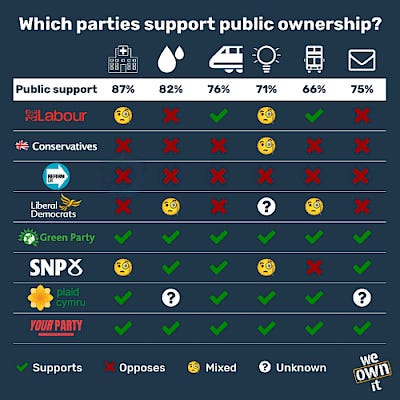
It billed itself as the insurgent voice of the people. But now Reform UK has been dramatically downgraded in a political scorecard after campaigners concluded the party is backtracking on promises to bring Britain’s broken utilities back into public hands.
The damning reassessment comes from campaign group We Own It, which monitors where political parties really stand on public ownership of essential services such as water, rail and energy. And their verdict is clear: Reform has slipped backwards.
The U-turn
At the last general election, Reform’s manifesto talked tough. It pledged a model of “50% public ownership and 50% UK pension funds” for key utilities, a policy pitched as giving ordinary Britons a stake in the nation’s infrastructure. But according to the updated scorecard, the party’s rhetoric has failed to translate into firm commitments or concrete action.
Campaigners say Reform has refused to back calls for full, permanent public ownership of failing water companies. Most notably, its MPs have not signed a public pledge to bring Thames Water into public ownership without compensation for shareholders, despite the company’s mounting debts, pollution scandals and public outrage over sewage dumping.
Instead, party leader Nigel Farage has poured cold water on sweeping nationalisation. He has spoken only of “short-term partial nationalisation” in limited circumstances: language that leaves the door wide open for services to be handed straight back to private investors once the crisis passes. In other words: socialise the losses, privatise the profits.
We Own It also highlighted Reform’s failure to commit to public ownership of energy companies, even as households continue to grapple with soaring bills. Nor has the party endorsed taking rail franchises permanently into public control. Reform is now the only party analysed by the campaign that gets a red cross on every category.
Sovereign wealth or donor wealth?
One of the few flagship ideas touted by Reform figures has been the creation of a sovereign wealth fund that might acquire strategic assets such as British Steel. But critics say this selective approach sidesteps the everyday essentials—water, energy and transport—that millions rely on, while leaving lucrative sectors exposed to private equity and overseas investors.
The downgrade also comes amid scrutiny of who funds Reform’s rise. The party has benefited from large donations from wealthy backers, including businessman Christopher Harborne, whose multimillion-pound contributions have bolstered party coffers. Detractors argue that such financial dependence inevitably shapes policy priorities.
Say-do-gap
We Own It’s scoring system assesses not only manifesto pledges, but public statements, voting behaviour and the likelihood of a party actually delivering on promises. In Reform’s case, the campaign concluded that the gap between headline-grabbing announcements and practical follow-through had simply grown too wide.
For voters drawn to Reform’s anti-establishment message, the downgrade raises awkward questions. Is the party truly prepared to wrest control of essential services from private shareholders? Or are bold slogans merely a stepping stone to power, after which cosy compromises will protect dodgy donors and polluting paymasters?
As Britain’s water pipes leak, energy bills bite and rail passengers endure cancellations and chaos, the stakes could hardly be higher. Reform UK may talk the language of disruption, but when it comes to public ownership, the party looks less like a revolutionary force and more like a familiar ally of moneyed interests.