


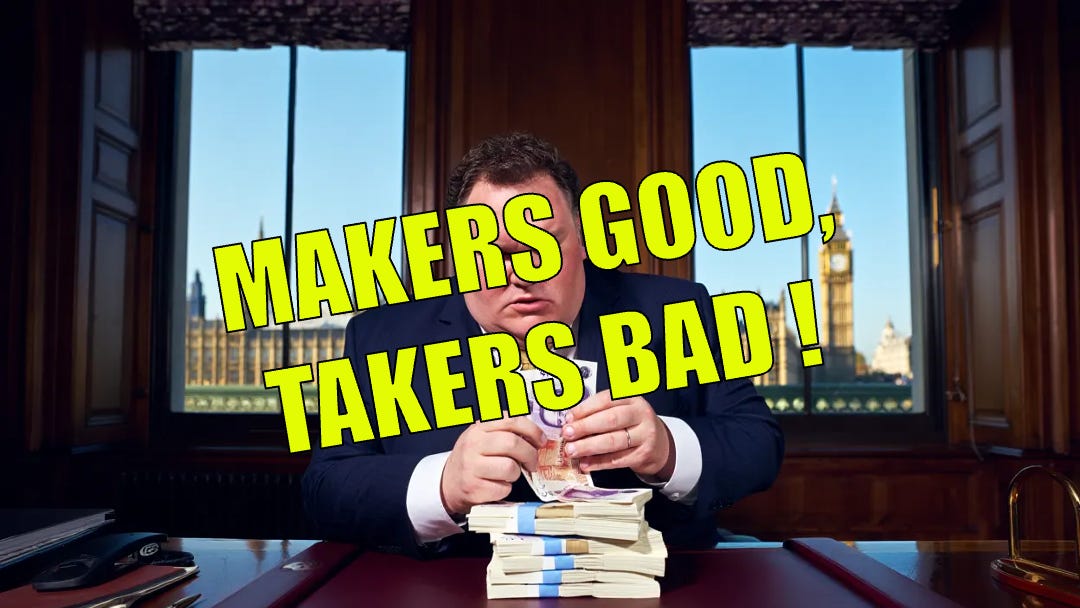
Britain has had enough. A new poll shows that ordinary people are turning their backs on the corporate fat cats and financial schemers who have been siphoning wealth off the economy while working families struggle to make ends meet.
The stark findings from a nationally representative survey, commissioned by the Fairness Foundation and carried out in January 2026, reveal a deep-seated British disgust with business models that are perceived as “extractive” rather than genuinely creative. In other words, voters are sick of companies that take and don’t make—and they want policymakers to act accordingly.
Makers vs takers
According to the research, the public clearly distinguishes between firms that create genuine value and those that extract wealth without giving much back. Tech innovators who bring new products to market and drug developers tackling major diseases still enjoy broad support. But firms that exploit monopolies, dodge tax, rip off consumers, or squeeze workers are increasingly taboo.
The message from voters could not be clearer: reward hard work and innovation; punish exploitation and rent-seeking. One of the most popular explanations offered by respondents for why certain businesses are unacceptable? Because “the system is rewarding the takers, not the makers.”
A nation fed up with a rigged system
The polling comes amid rising concerns about inequality, stagnant wages, and a sense that the economic deck is stacked against ordinary Britons. This evidence echoes recent debates about fairness and opportunity in British society, which have dominated headlines from the cost-of-living crisis to accusations of elite capture in business and politics.
Indeed, the Fairness Foundation’s own framework—the so-called Fair Necessities—argues that a truly fair society must ensure that people have their basic needs met, that opportunities aren’t blocked by structural barriers, and that rewards correspond to real contributions.
Many British voters clearly feel the system has failed these tests. Rather than seeing wealth created through invention and investment, they see profits being made by companies that game the tax system, cash in on shortages, or maximise returns through ruthless cost-cutting at the expense of staff and suppliers.
What voters really think
In the poll, fictional companies were used to test public attitudes—with striking results. A firm that developed an innovative new hairdryer that improved efficiency and reduced prices was widely approved of. In contrast, a water supplier with a regional monopoly that hikes bills drew widespread disapproval. Firms that specialised in tax avoidance or reselling tickets at inflated prices were met with outright hostility.
Interestingly, views on these business models remained consistent across political divides. While Conservatives were marginally more supportive of most company types than Labour voters, all groups showed strong resistance to extractive models. Women and lower-income respondents tended to be more hostile to exploitative practices.
What happens next?
Experts say the poll gives politicians a clear mandate: champion genuine wealth creation and clamp down on rent-seeking and exploitative firms. The Fairness Foundation believes that understanding the difference between “creating” and “extracting” wealth is crucial for rebuilding faith in the economy and strengthening the UK’s social contract.
Critics, however, warn that such attitudes risk stifling business and innovation if misapplied, and that the distinction between makers and takers is not always straightforward in practice.
But for many voters, the message is simple: Britain should reward effort, ingenuity and contribution, not schemes that skim off the top while leaving the rest of society to foot the bill.