


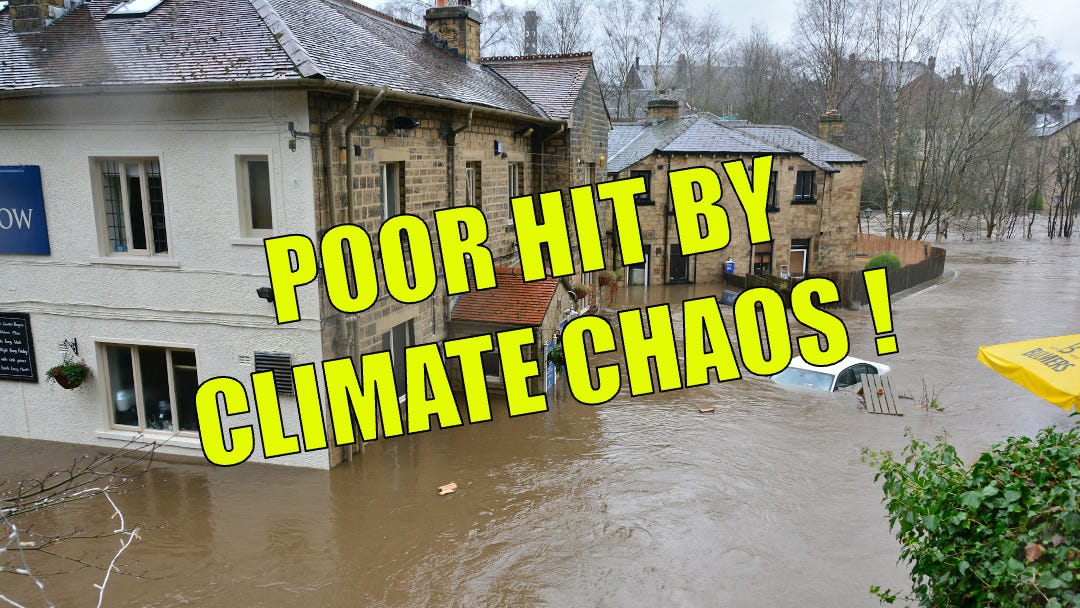
You have felt it at the checkout. You have felt it at the petrol pump. You have felt it when your energy bill landed on the mat. Now an official report confirms what millions of us already knew in our bones. When extreme weather hits Britain, it is the people with the least who get clobbered the hardest.
The Climate Change Committee’s new assessment is a 500-page wake-up call. Its most explosive finding? The poorest neighbourhoods in this country are over seven times more likely to be highly vulnerable to dangerous overheating than the wealthiest. They are over ten times more likely to be highly vulnerable to flooding.
Same country. Same storms. Wildly different odds.
A two-tier Britain
The report calls it a “protection gap”. We call it what it is. A stitch-up.
When the floodwaters rise in your street, the well-off cash in their insurance and rebuild. Many low-income families cannot get insurance at all, or face premiums they have no hope of paying. The report warns that by 2050 many homes in flood-risk areas “may not be able to access insurance due to lack of coverage or high premiums”, and that this “impacts those with low incomes the most”.
When the next heatwave bakes our cities, the comfortable retreat behind air conditioning. Pensioners on fixed incomes swelter in poorly built flats. The report projects heat-related deaths could rise from up to 3,000 a year today to as many as 10,000 a year by 2050. The dead will not be evenly spread across the postcodes.
When the power grid buckles and the lights go out, who picks up the tab? The report spells it out. The cost will eventually be passed onto households, again often impacting those on low incomes the most.
Your dinner is in the firing line
It gets worse. Forty per cent of the food on your plate is imported. When climate shocks hit the countries that grow it, prices rocket here. Extreme heat across Europe in 2022 pushed food prices up that was felt by many.
The report is brutally honest about what comes next. Crop failures abroad will lead to higher food prices, “hitting those on low incomes the hardest”. Ordinary families. Pensioners. Single parents. Working people who already cannot stretch the budget to the end of the month.
Who is responsible?
The committee’s Chair, Baroness Brown, writes that “what governments have been doing on adaptation clearly isn’t working”. She concludes that “whether or not to prepare for the changing climate is now solely a political choice”.
Not an accident. Not an act of God. A choice.
For years, the polluters have been raking it in while ordinary people pick up the bill. Their cronies in government have dithered, delayed and pretended this was somebody else’s problem. Meanwhile your roof leaks. Your bills climb. Your high street floods. Your kids’ school overheats. Your insurance gets cancelled.
The good news
Here is the part they will not put on the front page. We already know what works. Better cooling in homes. Proper flood defences. A secure water supply. Targeting the homes most at risk could cut heat deaths by more than half. Every pound spent on flood resilience saves five. Every pound on heatwave plans saves up to thirty.
This is not rocket science. It is a question of will.
For too long we have been told that protecting ordinary people from the chaos the polluters have caused is too expensive, too complicated, too political. The truth is the opposite. Doing nothing is the expensive option, and the bill always lands on the same doormats.
It is time to stop paying for their mess. It is time for fair protection, fair prices and a fair future. Together, we can demand it.