


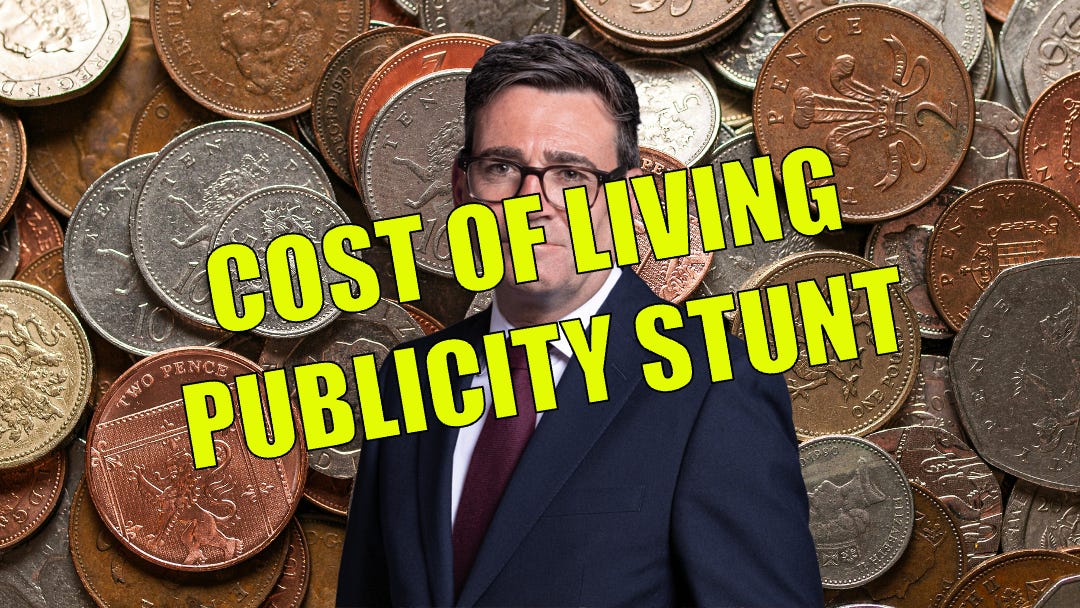
Britain has watched Andy Burnham tour the country asking about the cost of living, and delivered a verdict. Narrowly, it is a stunt.
New polling from More in Common finds 46% of Britons believe the tour is a publicity exercise designed to make the Prime Minister look good. 42% think it is a genuine attempt to understand what people are going through.
Maybe that split doesn’t look too bad in today’s political world, but the detail is worse.
Those who need Burnham most are the ones who believe him least
Among Britons who say they are very comfortable financially, 20% think the tour is genuine. Among those who are hard up, that figure falls to 5%.
Read it again, because it is the whole story. The further you are from an unaffordable bill, the more likely you are to think the Prime Minister genuinely wants to hear about unaffordable bills. The closer you are, the less you buy it.
People who have been squeezed for years develop an ear for this stuff. They can hear the difference between someone who is listening and someone who is being photographed listening.
Something has been offered, and it is not nothing
Burnham has not turned up empty-handed. VAT comes off household energy bills in October. Bus fares are capped at £2 across England. Rules forcing companies to make subscriptions easier to cancel, originally due next spring, have been pulled forward to January.
But this is where the tour runs into a wall it cannot walk around. The Prime Minister can shave VAT off a bill, but he does not set the bill. The standing charge lands whether the boiler goes on or not, £315 a year before a single kilowatt is used, and it takes a bigger bite the less you can afford to burn. The wholesale price moves on decisions taken in rooms he is not in.
Shadow chancellor Mel Stride says Burnham has “already run out of ideas”. Reform’s Robert Jenrick wants levies stripped from bills. All of them are arguing about the size of the sticking plaster.
The scepticism is strong
Here is what should worry Westminster more than any single number. This is not a left problem or a right problem.
The people telling pollsters they do not believe the tour are not organised. They have not been whipped into it by a party or a campaign. They are cleaners and delivery drivers and retail workers and pensioners who have watched governments of every colour arrive with a listening exercise and leave with a photograph. They have compared the promise with the direct debit and the direct debit won.
That shared judgement, arrived at separately by millions of people who agree on very little else, is the most honest piece of political analysis produced in Britain this summer.
Our Fair Future starts from the same place those 5% do. Not cynicism. Arithmetic. Clean energy generated here, sold at a price that reflects what it costs to produce, with the people who profit from expensive power no longer writing the rules. Secure work that pays enough to make a Tuesday survivable. Bills you can look at.
That is not a tour. It is a demand.
The Prime Minister’s bus will move on to the next high street this week, and the cameras will follow it, and somewhere behind the crowd a meter will keep spinning.